Evidence
How to Get Your Case File From Your Lawyer
When the representation ends, your lawyer must turn over the file you are entitled to. What counts under ABA Opinion 471, state rules, fees, and how to ask.
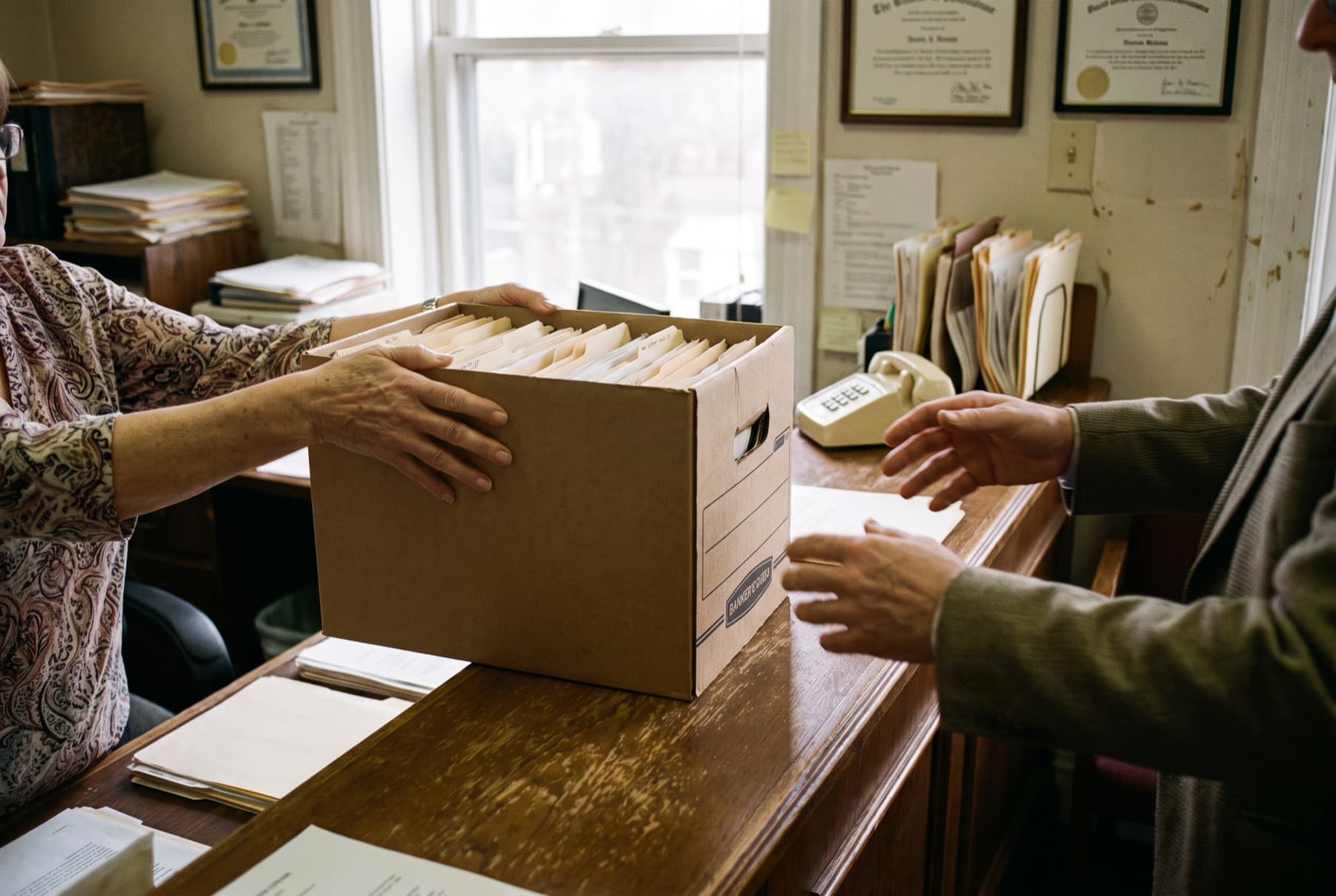
You have a right to your client file. When a lawyer's representation ends, for any reason, the ethics rules in every state require the lawyer to turn over the papers and property you are entitled to. At a minimum that means everything you handed over, everything filed in court, the signed documents, and the correspondence and evidence in your case. In most states you are entitled to much more.
The file matters. It is how a new lawyer picks up your case without missing a deadline, and it is the core evidence if you ever need to prove the old lawyer made a mistake. Here is what the rules say, how they differ by state, whether a lawyer can hold your file for unpaid fees, and how to ask for it in a way that works.
Key takeaways.
- Under ABA Model Rule 1.16(d), a lawyer whose representation ends must surrender the papers and property the client is entitled to. That duty applies even if the lawyer thinks you fired them unfairly.
- ABA Formal Opinion 471 (2015) says the minimum includes everything you gave the lawyer, court filings, signed contracts, correspondence, discovery, deposition transcripts, expert reports, and anything you paid a third party to produce.
- Most states go further and follow an entire file approach. New York's highest court held in 1997 that clients are presumptively entitled to the whole file, with narrow exceptions.
- California requires lawyers to release client materials promptly on request, whether the client has paid for them or not.
- Ask in writing, set a reasonable deadline, and if the lawyer stalls, a bar complaint is the usual next step. Lawyers have been disciplined for withholding files.
See if you have a case.
1 of 7
Six quick questions. Free, private, no obligation.
Do you have a right to your case file?
Yes. The ABA Model Rules of Professional Conduct, which nearly every state uses as the basis for its own rules, put the duty in Rule 1.16(d). Under ABA Model Rule 1.16(d), when a representation ends, the lawyer must take reasonable steps to protect the client, including "surrendering papers and property to which the client is entitled" and refunding any unearned advance fee.
Two points in the official comments matter to clients:
- It does not matter who ended the relationship. Comment [4] says a client may fire a lawyer at any time, with or without cause. Comment [9] adds that even if the lawyer believes the firing was unfair, the lawyer must take all reasonable steps to limit the harm to the client.
- Fee disputes are not a blanket excuse. The rule lets a lawyer keep papers only "to the extent permitted by other law," and Comment [9] says a lawyer may hold papers as security for a fee only to the extent the law allows. Several states sharply limit or forbid that, as explained below.
Rule 1.15 adds a separate duty: a lawyer must promptly deliver client property on request. ABA Formal Opinion 471 reads that to cover any documents you gave the lawyer, including originals like wills and deeds, whether on paper or in electronic form.
What counts as your file under ABA Opinion 471
In July 2015 the ABA's ethics committee issued Formal Opinion 471 to answer exactly this question. It described the minimum the Model Rules require and what a lawyer may keep.
| Must be surrendered (minimum) | Lawyer generally may keep |
|---|---|
| Anything you gave the lawyer | Drafts and mark-ups |
| Filed court papers, and papers ready to file | Internal memos and legal research |
| Signed contracts and other executed documents | Conflict checks and staffing notes |
| Court orders and records | Personal notes |
| Correspondence, including email | Hourly billing records |
| Discovery, deposition transcripts, expert reports, witness statements, exhibits | Notes on an ethics consultation |
| Legal opinions you asked for | A general assessment of you or your matter |
| Third-party reports you paid for | Documents revealing other clients' confidences |
ABA Formal Opinion 471 says that when a representation ends before the matter is finished, a lawyer may also have to turn over internal drafts and research if withholding them would harm the client, for example the latest draft of a filing due soon.
Opinion 471 also makes clear that email and electronic files count. The rules use "papers," but the opinion says that includes electronic records, and it encourages lawyers to agree with clients up front about how files will be kept and who pays for copies.
State rules: entire file or end product
States split into two camps, and Opinion 471 describes both.
- Entire file states (the majority). The client gets everything related to the representation unless the lawyer can show a specific exception applies. The Restatement (Third) of the Law Governing Lawyers takes this approach, saying a lawyer must let a client inspect and copy any document relating to the representation unless there are substantial grounds to refuse.
- End product states. The client gets the finished work (filings, correspondence, discovery, contracts, and the like), but not the drafts and internal notes that led to it. Opinion 471 cites ethics opinions from Alabama, Illinois, Kansas, Mississippi, and Utah as following versions of this approach.
New York
In Sage Realty Corp. v. Proskauer Rose Goetz & Mendelsohn (1997), New York's Court of Appeals held that once the relationship ends, and where no claim for unpaid fees is outstanding, a client is presumptively entitled to the attorney's entire file, with narrow exceptions. The exceptions include documents that would breach a duty to a third party and some purely internal firm papers.
California
California Rule of Professional Conduct 1.16(e)(1) requires a lawyer, on request, to promptly release "all client materials and property," which the rule defines to include correspondence, pleadings, deposition transcripts, experts' reports, exhibits, and physical evidence, in paper or electronic form, "whether the client has paid for them or not."
Texas
Texas Disciplinary Rule 1.16(d) allows a lawyer to keep papers relating to the client to the extent permitted by other law, but only if doing so will not prejudice the client in the subject matter of the representation. The Professional Ethics Committee for the State Bar of Texas said in Opinion 627 (2013) that a client normally has the right to obtain possession of the lawyer's files from the representation, and that storage costs are generally the lawyer's to bear.
Check your own state's page, such as California, New York, or Texas, for more.
Can a lawyer hold your file until you pay?
Sometimes, but less often than lawyers suggest. The traditional tool is a "retaining lien," a right to hold client papers until the bill is paid. Whether it exists, and how far it reaches, depends on state law.
- California: no. The rule requires release of client materials whether or not the client has paid for them.
- Utah: no. The Utah Supreme Court, in a case cited by Opinion 471 (In re Brussow, 2012), noted that Utah's rule requires file materials to be returned regardless of other laws or unpaid fees, and it publicly sanctioned a lawyer who held a file over a disputed deposition bill.
- Texas: only if keeping the papers will not prejudice you in the matter.
- New York: the Sage Realty presumption of full access applies where no fee claim is outstanding, so an unpaid bill can complicate a New York request.
Even where a retaining lien exists, the ABA Model Rules still require a lawyer to take reasonable steps to protect the client, so a lawyer who withholds a file needed to meet an imminent court deadline risks discipline. Opinion 471 cites a District of Columbia case, In re Thai (2009), in which a lawyer was disciplined after delaying the return of a client's file and actively obstructing the efforts of the client and the new lawyer to get it.
If the dispute is really about the bill, fee arbitration may resolve both issues at once.
Who pays for copying your file?
The Model Rules do not settle this, and practices vary. Opinion 471 encourages lawyers to explain in their engagement letters who pays for copies and when, and it agrees with a District of Columbia ethics opinion that lawyers and clients may make reasonable agreements about how files are kept and copied and who bears the cost.
A few practical points:
- Read your retainer agreement. If it says who pays for copies, that usually controls.
- Ask for the file electronically. Most of it likely already exists as PDFs and email, which costs little to share.
- If the lawyer wants to keep a copy for their own records, that is normal. The lawyer can pay to copy the file and give you the originals.
Under ABA Formal Opinion 471, the fact that a lawyer sent you copies during the case does not by itself excuse the lawyer from turning those materials over again when the representation ends. It may affect who pays for the duplicates.
How to ask your lawyer for your file
- Put it in writing. Email works, and a letter sent with tracking gives you proof of delivery. Keep a copy.
- Be specific. Ask for the complete client file, including correspondence and email, pleadings, discovery, deposition transcripts, expert reports, exhibits, and anything you provided. If you are in an entire file state, ask for the entire file.
- Say where to send it. Give an address or a secure upload link. If you have a new lawyer, you can authorize the file to go straight to them.
- Set a reasonable deadline. Ten business days is a reasonable ask for a closed matter. If there is a court date coming, say so and ask for the file sooner.
- Cite the rule once, calmly. A sentence referencing your state's version of Rule 1.16 is enough.
- Follow up once. If there is no answer, send a second, shorter request.
If the lawyer still refuses, file a bar complaint. Withholding a file is a concrete, provable ethics issue, and Opinion 471 notes that lawyers have been disciplined for it. See how to file a bar complaint.
Why the file matters for a malpractice claim
If you think your lawyer made a serious mistake, the file is the evidence. It shows what the lawyer knew and when, what deadlines existed, what advice was given, what settlement offers came in, and what was or was not done. An expert witness will need it to judge whether the lawyer met the standard of care.
Request the file as soon as you suspect a problem. Malpractice deadlines are short, and waiting weeks for a file can eat into the time you have. Check yours on the statute of limitations page, and see the checklist before you sue your lawyer.
If you think your lawyer's mistake cost you, a free case review takes about two minutes and can connect you with an independent attorney in your state who handles legal malpractice claims.
Common questions.
Is my lawyer required to give me my file?
Yes. When the representation ends, the ethics rules in every state require the lawyer to surrender the papers and property you are entitled to. At minimum that includes what you provided, court filings, signed documents, correspondence, and discovery, and most states entitle you to the whole file.
Can my lawyer keep my file if I owe money?
It depends on the state. California requires release of client materials whether or not you have paid, Utah requires return regardless of unpaid fees, and Texas allows a lawyer to keep papers only if it will not prejudice you. Even where a lien is allowed, a lawyer must not leave you unable to protect your case.
What is included in a client file?
Under ABA Formal Opinion 471, the minimum includes materials you gave the lawyer, court filings, executed contracts, court orders, correspondence including email, discovery, deposition transcripts, expert reports, witness statements, exhibits, and third-party reports you paid for. In entire file states you can also get most internal materials, with narrow exceptions.
How long does a lawyer have to give me my file?
The ABA Model Rule does not set a number of days, and California's rule says the lawyer must release client materials promptly on request. If a court deadline is coming, say so in your request and ask for the file right away.
Do I have to pay for copies of my legal file?
Sometimes. The ABA says lawyers and clients may agree on who pays for copies, so check your fee agreement. Asking for electronic copies usually keeps the cost low.
What can I do if my lawyer refuses to give me my file?
Send a written request with a deadline, then a follow-up. If the lawyer still refuses, file a complaint with the state lawyer discipline agency. Lawyers have been disciplined for withholding client files.
Sources.
Statutes, court rules, appellate opinions, and bar publications we relied on. See our editorial standards.
- 1.ABA Model Rule 1.16: Declining or Terminating Representation
- 2.ABA Model Rule 1.16, Comment
- 3.ABA Formal Opinion 471 (July 1, 2015), Ethical Obligations of Lawyer to Surrender Papers and Property to which Former Client is Entitled
- 4.Sage Realty Corp. v. Proskauer Rose Goetz & Mendelsohn, 91 N.Y.2d 30 (1997)
- 5.State Bar of California, Rule 1.16 (Declining or Terminating Representation)
- 6.Professional Ethics Committee for the State Bar of Texas, Opinion 627 (2013)
- 7.Texas Disciplinary Rules of Professional Conduct, Rule 1.16 (Declining or Terminating Representation)
- 8.ABA Model Rule 1.15: Safekeeping Property
Keep reading.
All guides
Claim type
Abandonment and no communication
Your lawyer disappeared, stopped returning calls, or walked away without protecting your case.

The process
How to Fire Your Lawyer (Without Wrecking Your Case)

Other ways to get money back
How to File a Bar Complaint Against a Lawyer
Evidence
Before You Sue Your Lawyer: The Evidence Checklist