Malpractice by what went wrong
Can You Sue a Lawyer for a Drafting Error?
A lawyer who drafts a contract, will, or deed that fails to do what you asked can be liable if you show the error cost you and a better result was possible.
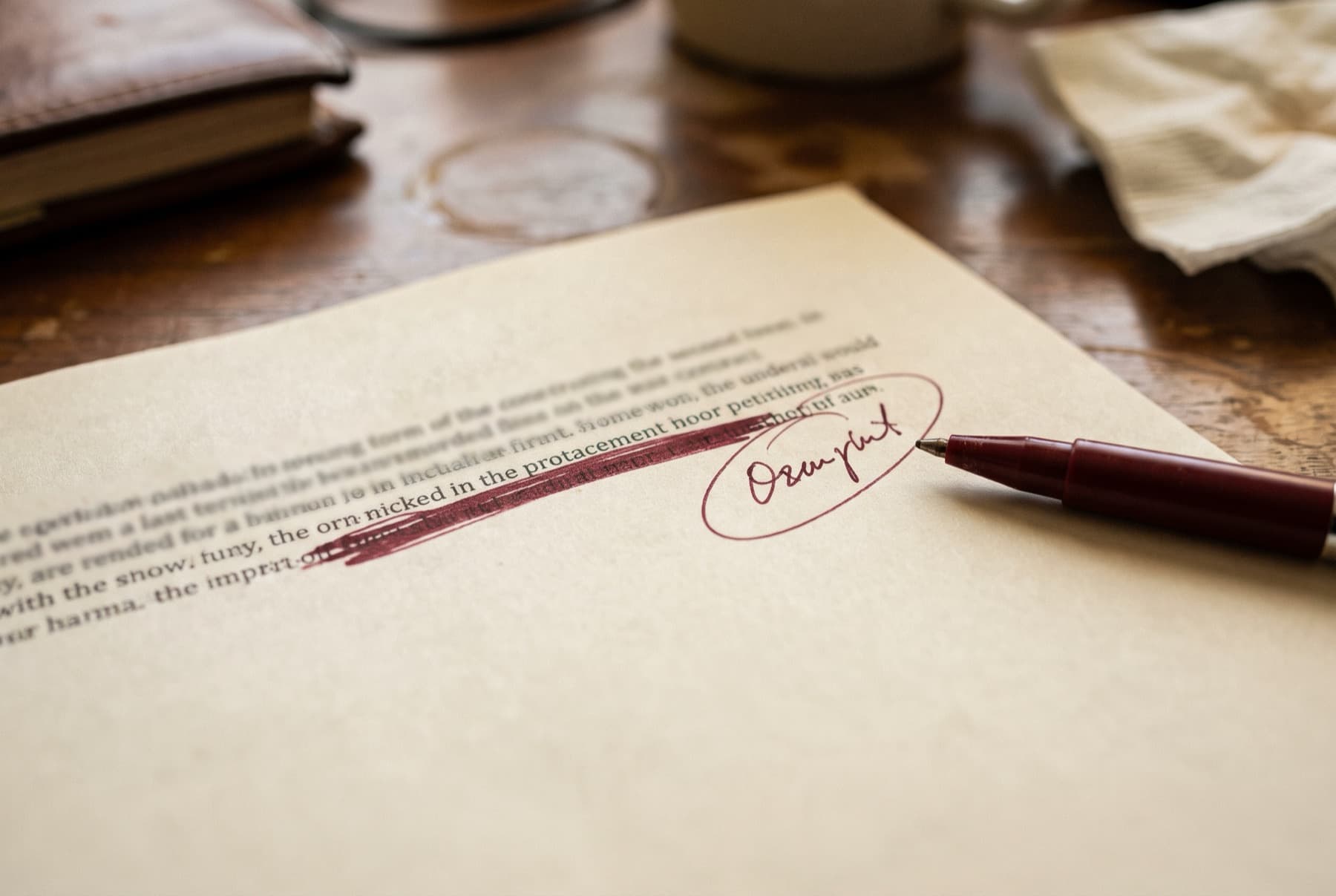
Yes. If a lawyer drafted a contract, will, trust, deed, lease, or settlement agreement that did not do what you asked, and that failure cost you money, you may have a malpractice claim. You will need to show what the document was supposed to accomplish, that a reasonably careful lawyer would have drafted it correctly, and that the error, not some other cause, led to your loss.
Drafting claims have an advantage many malpractice claims lack: the mistake is on paper. The hard parts are proving what you actually asked for and what would have happened if the document had been right.
Key takeaways.
- Drafting errors are a growing source of claims: the ABA's 2020 to 2023 Profile found claims tied to drafting errors rose 3.99 percent from the prior study.
- A drafting claim is strongest when the document plainly fails to say what you and the lawyer agreed it would say, and you can prove it.
- Courts do not treat every flaw as negligence. In Lucas v. Hamm (Cal. 1961), a will clause failed, but the lawyer was not liable because the rule involved was so confusing a reasonable lawyer could have missed it.
- In California, you must show you would more likely than not have gotten a better result without the error (Viner v. Sweet, 2003).
- Drafting errors often surface years later, so the start of the limitations clock can be the key fight.
See if you have a case.
1 of 6
Six quick questions. Free, private, no obligation.
Warning signs.
- A clause you asked for is missing from the final document.
- The document says something different from what the lawyer told you it said.
- A court or arbitrator ruled a key provision ambiguous or unenforceable.
- A will or trust was declared invalid, or a gift in it failed.
- A deed or lease has the wrong names, property description, or terms.
- You lost a dispute because the contract did not protect you the way you were told.
- A settlement agreement left out a release, payment term, or deadline you negotiated.
What to gather.
- The signed document and every draft you can find, with dates.
- Emails, letters, or term sheets showing what you asked the lawyer to include.
- The lawyer's notes or file, including redlines exchanged with the other side.
- Any ruling by a court or arbitrator interpreting or rejecting the language.
- Records of money you lost because of the error.
- Your engagement letter describing the lawyer's job.
What a drafting error looks like
A drafting error is a mistake in the words of a legal document. It can be something left out, something ambiguous, something that conflicts with the law, or a simple clerical mistake such as a wrong name or property description. The consequences show up later, when someone relies on the document and it does not hold.
The ABA's data shows how often this happens. In the ABA's Profile of Legal Malpractice Claims covering 2020 to 2023, preparing, filing, and transmitting documents was the activity behind 35.66 percent of malpractice claims, and claims tied to drafting errors rose 3.99 percent from the prior study.
A leading example is Viner v. Sweet (Cal. 2003). Business owners sold their interest in their company, and their lawyer negotiated the termination agreement. The clients said he led them to believe the agreement protected their indemnity rights and their right to work in film and television, and that a payment default would void the noncompete. The contracts did not say so. A jury found the lawyers liable on seven separate claims arising from the deal documents and awarded $13,291,532.
When a drafting mistake is malpractice, and when it is not
To be malpractice, the error has to fall below the standard of care: what a reasonably careful lawyer in that field would have done. Leaving out a clause the client specifically requested, misstating a basic term, or ignoring a well-known legal requirement usually meets that test.
Not every flawed document does. In Lucas v. Hamm (1961), the California Supreme Court held that a lawyer whose will provision violated the rule against perpetuities was not negligent, because that rule was so complex that a reasonably careful lawyer could have made the same error. Courts also protect reasonable choices between two acceptable ways of drafting a clause. See what is not legal malpractice.
Another common defense is that the client approved the language. That defense is weaker when the lawyer told you the clause meant something it did not, as the clients alleged in Viner. It can also overlap with negligent legal advice, since explaining a document is part of drafting it.
Who can sue over a badly drafted document
Usually only the lawyer's client can sue, because of the privity requirement. Wills are the big exception in most states. In Lucas v. Hamm, California allowed the people the will was meant to benefit to sue the drafting lawyer even though they were not clients.
Texas takes the opposite view. In Barcelo v. Elliott (1996), the Texas Supreme Court held that a lawyer hired to draft a will or trust owes no professional duty of care to the people named as beneficiaries, even where, as there, the trust was found invalid after the client died. The Texas court acknowledged that most states addressing the question had relaxed the privity rule for will beneficiaries, citing decisions from California, Connecticut, Florida, Illinois, Pennsylvania, Wisconsin, and several other states. For more on will and trust claims, see wills and estate planning malpractice. For deeds, leases, and closings, see real estate lawyer malpractice.
What you have to prove
You must prove duty, breach, causation, and damages. Causation is where drafting claims are won or lost. In a lawsuit, the question is whether you would have won. In a transaction, the question is whether you would have ended up with a better deal.
In Viner v. Sweet (2003), the California Supreme Court held that a client suing over transactional work must show that, but for the malpractice, it is more likely than not the client would have obtained a more favorable result. That can mean proving the other side would have agreed to better language, or that you would have refused to sign. The court said circumstantial evidence can be enough, and you do not need the other party to admit it would have agreed.
Expect the lawyer to point to other causes. If you had accountants or business advisers review the deal, or if you pushed to close quickly despite warnings, the defense will argue those factors, not the drafting, drove your loss. Contemporaneous emails showing what you asked for and what you were told are the best answer.
Most drafting claims need an expert witness to explain what competent drafting would have looked like. See legal malpractice expert witnesses and the case within a case.
Common drafting errors and how they are fixed
Drafting mistakes tend to fall into a few families. Knowing which one you have helps you figure out whether the document can still be fixed, and what a claim would need to prove.
| Type of error | Example | Possible fix |
|---|---|---|
| Omission | A requested contingency or release left out | Amendment, if the other side agrees |
| Ambiguity | A clause two sides read differently | Negotiation, or a court or arbitrator decides |
| Legal defect | A term that violates a statute or rule | Often none; the term may be void |
| Clerical error | Wrong name, date, or property description | Correction instrument or court reformation |
| Execution error | A will not signed or witnessed properly | Often none after death |
A drafting error that can still be corrected, such as by amendment or a court order reforming the document, often limits your damages to the cost of the fix. That is why a new lawyer should look at repair options before anyone talks about a lawsuit. Fixing the document is usually faster than suing over it, and a court may expect you to take reasonable steps to limit your loss.
Some errors cannot be repaired. A will that was not properly executed usually cannot be fixed once the person has died, and a contract term that violates a statute may simply be unenforceable. In Viner, the clients argued the noncompete violated California's statute limiting such agreements, and an arbitrator rejected that argument, which left them bound by the language. Those are the cases where a malpractice claim becomes the main remedy.
Watch for overlap with other claims. If the lawyer also represented the other side of the deal, the problem may be a conflict of interest as much as a drafting error. If the lawyer never told you about a change the other side made, it may also be a failure to communicate.
How damages are measured
The goal is to put you where a correctly drafted document would have put you. Depending on the case, that can include:
- Money you lost because a clause failed, such as unpaid amounts or lost indemnity.
- The value of a better deal you would have obtained.
- Legal fees spent in litigation or arbitration caused by the ambiguity.
- For wills, the gift the beneficiary should have received.
The size of the award in Viner shows how quickly these losses add up, and how carefully courts police causation. In Viner v. Sweet, the Court of Appeal cut a $13,291,532 jury award to $8,085,732, and the California Supreme Court then sent the case back over the but-for causation test. Read more in how much a legal malpractice case is worth.
Deadlines and what to do now
A drafting error often causes no harm until the document is tested, which can be years after signing. States handle that gap differently. California Code of Civil Procedure § 340.6(b) starts the limitations period on a claim based on a written instrument whose effective date depends on a future event when that event occurs. Otherwise, California generally allows one year from discovery and no more than four years from the error. Other states use their own discovery rule or a statute of repose. Check the statute of limitations page for your state.
- Collect the signed document, all drafts, and your instructions to the lawyer.
- Get the lawyer's client file.
- Ask a new lawyer whether the document can still be fixed, such as by amendment or a court action to reform it.
- Write down when the problem first surfaced.
If you think a lawyer's drafting mistake cost you, a free case review takes about two minutes and can connect you with an independent attorney who handles legal malpractice claims in your state.
Common questions.
Can I sue my lawyer for a mistake in a contract?
Yes, if the mistake fell below what a reasonably careful lawyer would have done and it cost you money. You usually must show you would have gotten a better result with correct drafting. Written proof of what you asked for is very helpful.
Is a typo in a legal document malpractice?
It can be if it changes the meaning or effect of the document and causes a loss. A harmless typo that can be corrected without cost usually does not support a claim, because there are no damages.
Can a beneficiary sue a lawyer for a badly drafted will?
In most states, yes, if you were an intended beneficiary and the error defeated your gift. Texas does not allow beneficiaries to sue the drafting lawyer, under Barcelo v. Elliott (1996).
What if I signed the document and approved the language?
Approval does not automatically bar a claim, especially if the lawyer told you the language meant something it did not. The lawyer's explanation of the document is part of the service you paid for.
When does the clock start on a drafting error claim?
It depends on the state. In California, a claim based on a document whose effect depends on a future event starts running when that event happens. Other states use discovery rules or repose periods.
Sources.
Statutes, court rules, appellate opinions, and bar publications we relied on. See our editorial standards.
- 1.ABA Profile of Legal Malpractice Claims 2020 to 2023, summary, Minnesota Lawyer
- 2.ABA Profile of Legal Malpractice Claims 2020 to 2023, summary, ALPS
- 3.Viner v. Sweet (Cal. 2003), Justia
- 4.Lucas v. Hamm, 56 Cal.2d 583 (Cal. 1961), case brief
- 5.Barcelo v. Elliott, 923 S.W.2d 575 (Tex. 1996), opinion PDF
- 6.California Code of Civil Procedure § 340.6